Sunday, June 16, 2024

The beauty of Button Weeds or Golden Buttons "weed"


Button Weeds (Cotula Coronopifolia) also known as Golden Buttons. Personal archives, June 2024.

Though Button Weeds (also known as Golden Buttons, Water Buttons, Brass buttons) are consider  weed, they look so pretty next to the lake or ponds edges, in a low mat formation in a naturalistic landscape (garden). I have taken my pictures at the Huntington Beach Central Park, where they bloom next to the local lake under full sun.

This perennial plant is native from South Africa and it is also found in North America, South America and Asia. It reproduces through seeds. The appearance is of button-like tiny flowers, yellow or white, with lance-shaped leaves. The tiny flowers form a cluster that cannot be appreciated from afar. I have taken some of these photos with a 300 mm macro lens, which helped me understand their morphology.

The seeds are hard and can persist in the ground for long years. Hence the plant's duration as a weed or better said, as a lush ground cover.

Such a nice field of Button Weeds, Golden Buttons during Springtime. Personal archives, April 2024.

The Button Weeds (Cotula Coronopifolia) is growing among marshes at the edge of the Huntington Beach Central Park lake. Here, they appear as the yellow "line" in the middle, adding texture and color. Personal archives, June 2024.


Button Weeds, Golden Buttons, seen as part of the landscape. They are a great addition of texture and color. Personal archives, April 2024.

Button Weeds (Cotula Coronopifolia) is growing next to dry branches here. I enjoyed the green tones as seen through the sunlight. Personal archives, June 2024.

Wednesday, May 15, 2024

Cactus garden at the South Coast Botanic Garden


It has been a real pleasure for me to visit the South Coast Botanic Garden again. There is the all over exhibition of "Bloom" which is all the splendid Spring flowers blooming in the garden, being the roses the most beautiful of them. But the cactus garden is fantastic as well. 
I am sharing here some of pictures in such a splendid day of last April. All pictures from my personal archives, 2024.


It is very interesting to walk among the cactus and succulents of diverse scale, arranged with rocks in a desert landscape.


This picture (above) shows a more colorful combination and I like how the perspective closes with taller species and finally there is the trees background. The palm trees species on the left.

See how the trees and the palm trees of the background break the lower scale monotony.

A play of textures, light and shadow.

White rocks here while in some areas (see below) the rocks are darker and next to a red flowering bush.


The palm trees in the background, see the different scales.


Maybe the only critical part is that looking at the cactus garden from the road curve, we perceive it as isolated and not part of a "desert". 

Friday, May 10, 2024

Adding meaning to trees, humanizing trees

A gas mask on top of a dead tree. Photo credit Anadolu/Getty Images. Downloaded from The Guardian.com

 I was reading the article "Must landscapes mean? (by Marc Treib-1995, Theory of Landscape architecture) when I came across with this photo (above) on the Guardian.co, that impacted me so much.  In my understanding, we may have a free interpretation of its meaning, who knows, maybe it was just a casual idea, but who can take away the explicit (at least for me) horror of the war from this dead tree with the deadly mask on top? Doesn't it look like a humanized tree that has become an anonymous soldier?

"In its uncanny way the gas mask humanises this tree in Ukraine, lending it an identity that is contrary to what happens whenever a human is obliged to wear one. Everyone, man or woman, attractive or unattractive, ends up looking the same. What we have here, then, is a highly individualised form of anonymity that is in keeping with one of the most solemnly familiar species of war memorialisation: the unknown warrior. This was instituted in Britain in 1920 in the stunned aftermath of the first world war during which time the experience of the warrior had begun to acquire a quality of passivity. By the end of the second world war combatants and civilians alike shared the helpless experience of enduring bombardment, either from the air, by planes or by land from artillery. So the unknown figure of the wars of the 20th century and, of course, those now under way in Ukraine and Gaza, might well be the unknown non-combatant. Through no fault of their own, men, women and children become caught up in something dreadful, as might happen to a tree. A further layer of anonymity or unknown-ness is provided by the caption which identifies the agency but not the photographer who actually took this remarkable picture."

Coming back to Marc Treib's article, he explains how professionals from different fields of expertise, imbue meaning to landscape: "Cultural geographers, calling a collective body of study (...) interpret ordinary landscapes by first looking at the world around them; in their eyes, meaning congeals in setting, dwelling and use- and not alone from the designer's intention. Historians of gardens and landscape architecture tell us of those makers of places past who tried earnestly to create landscapes in which meaning would be apparent and understood (....) to convey to the visitor a message as well as a sensuous impression".
But this is all on the basis of users and designers sharing a similar cultural and social background. Hence, the communication (and significance) is achieved. He then explains that when people do not understand the meaning given by the maker (designer, architect) then there is no meaning because of lack of communication. In consequence "a plastic or metal plaque normally provides its meaning to the residents with credits to the designer (...)"
The Anadolu's photo obviously does not need further explanation, and it deeply moves me like a piece of art.

A tree "intervention". Photo by Myriam Mahiques, personal archives, 2024.

Among the different styles that Treib mentions as forms of giving meaning to landscape, there is the vernacular arrangement (I'm avoiding the word design) which typical example would be the concrete frogs, gnomes, that we must have seen in many houses. Taken away from their context, in Treib's words "multiplied by the hundreds and painted gold, they are not longer the common vernacular element they once were, but fodder for High Style designers". 
I am sharing here an example of vernacular "landscape ornaments" on a tree branch. This is very close to where I live and I'm following up the minor changes. I am assuming this tree branch appropriation is done by a child, but again, who can tell? Should I intellectualize the arrangement? I could, but I prefer to enjoy this fresh, innocent intervention, that gives me food for thought every time I walk along this building. And repeating Treib's question, do we need to have a meaning for this? I suppose not, I am just happy with the feeling it produces in me, the surprise, the fun, the curiosity..... 
The following pictures were taken in April 2024 and are part of my personal archives.


In time, this "intervention" is being modified. There's a bag a toy a the bottom branches intersection now. It is still picking up my interest. Personal archives, June 2024.
 

The Rainbow Bridge in Long Beach CA

A view of the Rainbow Bridge from the front plaza of the Convention Center in Long Beach, California. Personal archives, February 2024.

Back in February 2024 I had to make a consultation for some plans at the Planning Department of the City of Long Beach, CA, and I decided to take some time off to walk around the shoreline and take interesting pictures of the bridges, including the Brutalist structure at the end of the old bridge.
It was a great decision, since it allowed me to "discover" the Rainbow Bridge -designed by SPF Architects- at the Long Beach Convention Center, in which I've noticed all the lighting inside the organic structure but I did not have the pleasure to see them turned on. 
The link below has some videos and pictures of how it looks (so colorful) at night.

For technical information please read from Archdaily.com:


So, I was focused on the landscape design on the side and along the bridge. It is a beautiful landscape, full of native species and roses as well, which were not in bloom yet, as it was late Winter. 
See there are some "benches" of rounded stones. 
I'm sharing here some photos of my walk through, all of them from my personal archives, February 2024.

The front facade of the Long Beach Convention Center on the left.

A "bench" on my way.

The organic structure and the multiple lighting.

The Organicism of the Rainbow Bridge as seen from below.

On the right side, there are some restaurants.

The end of the bridge while arriving at the Terrace Plaza. Except for the fountain, the landscape at the Terrace Plaza looks old and without any improvement. The square planters look pretty dull. It's like the great design of the bridge has not been fully integrated to the plaza.

I took this picture at the edge of the Terrace Plaza, after going out of the Rainbow Bridge. You can tell the difference of landscape design and care. Definitely the Terrace Plaza needs and improvement.

Monday, April 1, 2024

Christopher Columbus Waterfront Park: cubist space - volumetric space review


Wide angle view of Christopher Columbus Waterfront park. Personal archives, 2024.

I had the chance to visit and walk around the Christopher Columbus Waterfront Park in Boston, Massachusetts last March. Maybe not the ideal time, since it was at the very beginning of Spring and the plants and trees were not blooming yet. 

I am sharing here some of my photos and a brief description from the park website: 

"Located between Boston’s Commercial and Long Wharves, this site was once populated by industrial buildings that served the city’s shipping industry. In the 1960s the Boston Redevelopment Authority funded the construction of public spaces, including a “Walk to the Sea” from Quincy Market to the waterfront. In 1974 the landscape architecture firm Sasaki, Dawson & DeMay created a waterfront park on filled land that became the harbor’s public access point. The design drew on the site’s history, using cobblestones and brick paving, wooden structures, and a bollard-and-chain system along the water to mimic the old bulkhead. On the nation’s bicentennial, thousands watched from the newly dedicated park as the “Tall Ships” paraded into Boston Harbor. 
In 1999 a new design by the landscape architecture firm Halvorson Company saw the installation of a new performance area and additional lawn space that opened up views of the harbor. Framed by Atlantic Avenue, the park is screened from traffic by groves of sycamores. A central lawn is bordered by a paved walkway that connects the park’s central features, including the Rose Kennedy Garden and an open promenade framed by Sasaki’s Lamella truss shade structure, which is draped in wisteria vines. A circular fountain demarcates the park’s southwest entrance. To the north, a linear brick path leading from the street to the harbor separates the playground and the Massachusetts Beirut Memorial (1992) from the lawn. In 2020, during a period of social unrest, the park’s namesake statue was beheaded and subsequently put in storage."

The oversized arbor or trellis in the Waterfront Park. Personal archives, 2024.

I am currently reading "Theory in Landscape Architecture", edited by Simon Swaffield, -University of Pennsylvania Press, 2002-, and to my surprise, there is an essay by Patrick Condon called "Cubic Space, Volumetric Space (1988)" (page 84) that compares the Piazzetta San Marcos in Venice with the Christopher Columbus Park. 

Condon states that Cubist space is made by placing solids in space (I see it as a conceptual mistake), while volumetric space is made by enclosing space. Volumetric space can be small as well and is related to human scale. As an example, he shows The Piazzetta San Marcos, a flat empty plaza surrounded by buildings. And as a Cubist space, he explains the design of Christopher Columbus Park which is lacking of enclosure and the walking surface is not leveled.

The photos from Patrick Condon's article, depicting the Piazzetta of San Marcos and the Christopher Columbus Waterfront park. See the fountain that is missing from my photos, since I was walking on the other side. Personal archives, 2024

Regarding the changing walking level that he describes as "highly complex, a relief sculpture that prevents the participant from perceiving it as a floor", I have to say that apart from the staircase that I have taken coming from Quincy Market, and crossing Atlantic avenue, I have not noticed any significant slope. Of course, as seen in my first photo above, the grading is not flat, but not to the point of being  sculptural. Yes I agree that this type of asymmetrical open design is more dynamic and the arbors (trellis) look like oversized sculptures that can be traversed. Compared to San Marcos, the landscape design offers a lot of visual stimuli.
Considering the strict meaning of the term "Cubism", I do not see that the Christopher Columbus park design could be labeled as this style. Mainly, because Cubists artists broke up an element (an object, a person...) and re-arranged it in an abstract morphology. This park has added elements on the ground, with a design criteria, but there is not a break up of a main idea.

Christopher Columbus Park, with the arbor on the right and the street on the left. On the background, some Downtown buildings. Note that the only "green" tree is this pine, while the rest of the trees are still bare. Everywhere I walked in Boston I have seen the same bare trees, I was wondering why there is no combination of species. Personal archives, 2024.

One of the arbors-trellis with the perspective towards Atlantic avenue. Personal archives, 2024.

The staircase from Atlantic avenue. Personal archives, 2024.

Facing the water, note the marine elements to determine a border which is not specifically for safety, at least the way I see it. The water is the park limit. Personal archives, 2024.

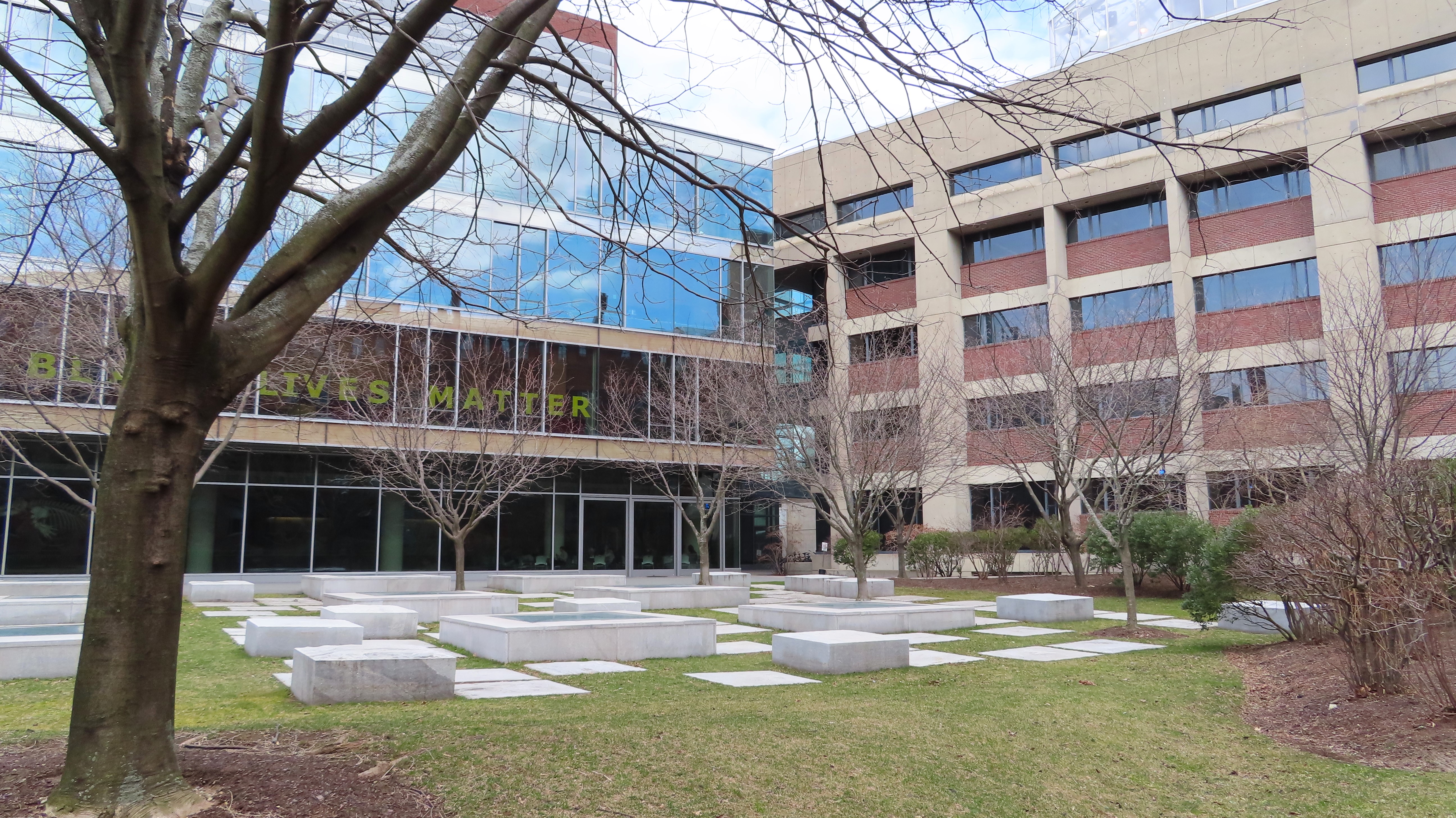
To Patrick Condon's examples I will add an intermediate one. This is a plaza inside Harvard Campus. 
There are buildings surrounding the plaza (like the volumetric space) but at the same time there are some sculptural elements, geometrically arranged, where we can walk in between without a single point of view perspective (like the Cubist space he mentions). 
Some are planters, some are like seats and the flat ground has the same concept with squares on the grass.

A contemporary plaza inside Harvard campus. Cambridge, MA. Personal archives, 2024.

Sunday, March 31, 2024

Drifting: walking in relation to the terrain


A path in the desert. Las Vegas, NV. Personal archives, 2021.

I have chosen the name of this blog "Inbuilt Landscape" as a representation of my inner terrain-desire to be in contact with nature, and feel it as part of me. Being a child, I used to walk alone among Eucalyptus trees in my father's farm, crushing the leaves on the ground, smelling the leaves, sometimes graving my name on the trunks.... And when I went to a beach city for vacation, my favorite sidewalks where those adjacent to pine trees with branches I liked to touch and smell while walking. Being in any city, the detours to hidden streets are my favorite ones. Even in cemeteries, my passion is looking inside all mortuary buildings and walking randomly in a search for abandoned tombs. 
What I did not know at the time of my childhood, was that I have always been an unconscious situationist practitioner of "drifting" or "dérive," with the difference that I prefer to walk alone, rather than in small groups, and discover the "mystery" of the surroundings by myself. 
From Theory of the Dérive. Guy Debord Les Lèvres Nues #9 (November 1956) reprinted in Internationale Situationniste #2 (December 1958) Translated by Ken Knabb:

ONE OF THE BASIC situationist practices is the dérive [literally: “drifting”], a technique of rapid passage through varied ambiances. Dérives involve playful-constructive behavior and awareness of psychogeographical effects, and are thus quite different from the classic notions of journey or stroll. In a dérive one or more persons during a certain period drop their relations, their work and leisure activities, and all their other usual motives for movement and action, and let themselves be drawn by the attractions of the terrain and the encounters they find there. Chance is a less important factor in this activity than one might think: from a dérive point of view cities have psychogeographical contours, with constant currents, fixed points and vortexes that strongly discourage entry into or exit from certain zones. But the dérive includes both this letting-go and its necessary contradiction: the domination of psychogeographical variations by the knowledge and calculation of their possibilities. In this latter regard, ecological science — despite the narrow social space to which it limits itself — provides psychogeography with abundant data.

An informal path at the Long Beach Green Belt, CA. I took this photo with a special interest in the cactus scale. Personal archives, 2023.

Walking down an informal path to the lake among Eucalyptus trees. Note the colors, the light and shadows. Huntington Beach Central Park, CA. Personal archives, 2023.

I'd call this path "the light at the end of the tunnel", that's they way I felt when I walked along this path at the South Coast Botanic Garden, Palos Verdes Estates, CA. Photo from my personal archives, April 2024.

In this post, I am applying the term "drifting" to walk in landscape. Here I am sharing some of my impressions -which I love to keep represented in photographs-. It is important to see and feel the sounds, textures, enjoy the -healing- forest, the colors, the smells, the light and shadows.

Walking along a path in the Secret Garden of Huntington Beach Central Park, CA. Personal archives, 2022.

Walking along a path in the Secrete Garden of Huntington Beach Central park, CA. Here, at the fork, we have the choice of taking one path or the other. This will lead us to a different experience. Personal archives, 2022.

A path surrounded by cactus and succulents. Rancho Dominguez, CA. Personal archives, 2019.

Phil Smith, in his book Enchanted Things (Triarchy Press, 2014, page 70) illustrates the concept in this poetic way:
"When walking in relation to the terrain is complemented by a dancing in relation to entangled inner and outer lives (what the choreographer Siriol Joyner calls "mining", the extractive counterpart to our construction of an inner landscape), then this is where the resources of an otherwise irrecuperable surplus can be spent: in the reconstruction of interiority. 
But the starting point is not within, subjectivity has been too damaged recently to sustain a simple quietist mysticism. Instead, the increasing scatterings of enchanted objects in the streets are the required things "ready-to-hand" (or rather, escaping Heidegger, "ready-to-tentacle") to fashion new inner landscapes of terrain-desire."

For further information, please read my interview with Phil Smith on concepts of Mythogeography:

My photo of an "inner path" in Rancho Dominguez, CA, to illustrate Phil Smith's words. Personal archives, 2019.

Wish trees at Yoko Ono's The Broad exhibition

  There is this on-going Yoko Ono's exhibition at the Broad Museum in Los Angeles, and though Yoko is not one of my favorite artists, I ...