Tuesday, March 7, 2023

Water Garden in Tochigi

 
Photo by Iwan Baan

Today I am sharing a landscape design from 2018, a beautiful water garden in Tochigi, Japan. 

I see it as a fractal garden design with healing, calming, characteristics. Each reflection, similar and different at the same time. There is not a single detail to miss here.

The idea that architecture is a form of nature has become a maxim that the firm Junya Ishigami + Associates faithfully follows in its work, an oeuvre now enriched by the Botanical Garden Art Biotop: Water Garden in Tochigi, Japan. The singularity of this project lies in all the recycling it involves: on the one hand, Ishigami has reused hundreds of trees that were supposed to be felled altogether, and on the other, he understood that taking advantage of an existing irrigation system would be the best way to create the watery soil on which a new kind of natural environment that has much to do with architecture would be able to thrive.

Photo by 9 Monkeys (Google)

Photo by O Kaneko (Google)


‘the primary objective of this project was to create a new form of nature as an extension of nature as we now know it; the future of nature through the eyes of man. the site was originally heavily wooded before it was cleared for rice fields. later, it became meadowlands. by maximizing the environmental potential of this land, we will create a new landscape that fuses ‘density’ and ‘relationship’ which do not coexist in nature.’ says junya ishigami to designboom.

Photo by Tao Tao (Google)

Photo by Yaziret E B (Google)


The landscape of Amorepacific Headquarters


Today I have been reading about British architect Sir David Chipperfield, who has just been announced as the Pritzker winner 2023, the highest recognition in the architecture field.
From all his work, I am sharing some interesting pictures of the landscape design for the Amorepacific Headquarters in Seoul, South Korea, 2017. The photographs belong to Noshe, David Chipperfield Architects, Ute Zscharnt, and were downloaded from ArchDaily where you can read the building description in the architects' own words.
I find the view through the sculptural trees fascinating. And the combination and contrast of the rigid facades grid, with the tortuous thin trunks and the rounded planters with lots of ferns. 
The trees look so ethereal and permeable like the facades per se. Note the lighting and the floor reflections.


As described by the architects: "Nature permeates the building right up to the roof gardens, where large trees express their sculptural quality complemented by amorphous water basins."

The trees scale and the translucent floor. See how the planter is square and flat in the circulation. 

The human scale.

Another translucent element in the floor, which has a square grid.

The trees scale in the overall magnitude of the building

The "hollowed" cube and the technical grid so beautifully inserted in the existing environment. See how a different grid is used in the building on the right.

One of the floor plans with the trees planters

One of the floor plans with the trees planters


Thursday, February 23, 2023

(Edible) Nasturtium Tropaeolum Majus


Close up of Nasturtium Tropaeolum Majus. Photo by Myriam Mahiques, 2021. Personal archives.

Long years ago, a friend of mine gave me some packages of Nasturtium seeds, of different colors.

Planting them gave me the joy of filling out my tiny garden with beautiful leaves and flowers. The plants spread very quickly, under the sun and the shadow. The cons, there were lots of snails reproducing under them.

I was curious about this plant -that resulted invasive for me-, and I've found out that the whole plant, including the flowers and seeds, are edible. The seeds are used to replace capers.
So I decided to prepare a salad for me, and it tasted pretty peppery, somehow similar to Watercress and Radish. 
The snails began eating other plants, and finally I had to remove all the Nasturtiums. Now I like to take pictures of them at the local park, observe the bright color of the flowers in contrast with the light green of the leaves, which are a little translucent through the sunlight, and one is able to see all tones of greens in one single plant.

Reading on Wikipedia, I see that Nasturtium is a genus of Watercresses and there is a clarification: 

"The genus Nasturtium should not be confused with the ornamental garden plant, usually grown as an annual, that is commonly known as nasturtium (Tropaeolum majus). Though not closely related, the leaves of the garden nasturtium also have a peppery taste."


Close up of Nasturtium Tropaeolum Majus. Photo by Myriam Mahiques, 2021. Personal archives.

A young lady resting in a "sea of Nasturtium". Here one can see how invasive the plant is. 
Photo by Myriam Mahiques, 2021. Personal archives.

From Wikipedia:

"Tropaeolum majus, the garden nasturtium, nasturtium, Indian cress or monks cress, is a species of flowering plant in the family Tropaeolaceae, originating in the Andes from Bolivia north to Colombia. An easily-grown annual or short-lived perennial with disc-shaped leaves and brilliant yellow, orange or red flowers, it is of cultivated, probably hybrid origin. It is not closely related to the genus Nasturtium (which includes watercress)."

One of the most interesting aspects, at least for me that I like to take macro photos in nature, is the plant "Lotus effect", it means the leaves have a "waxy" condition that when water falls on the leaves, they clean themselves. 

Wild radish (Raphanus Raphanistrum)


A dreamy view of Wild Radish flowers. Photo by Myriam Mahiques, 2021. Personal archives

The beauty of the Wild Radish purple flowers. Photo by Myriam Mahiques, 2021. Personal archives

I like to find edible wild plants and flowers, and I try them if I can. Usually I can find a few edible plants at the Huntington Beach Central Park, but I don't dare to cut the plant or flowers, due to respect to the park and all the volunteers working there.

Anyway I can enjoy the view of those plants close to the local lake. Though the flowering period is Summer, the mild weather of California allows the Wild Radish to be in full bloom even in Winter, by the time I have taken all the pictures posted here. All pictures belong to my personal archives, please do not share without my permission.

Close up of Wild Radish leaves.

Close up of Wild Radish flowers

The following excerpts are from Wikipedia:

"Raphanus raphanistrum, also known as wild radish, white charlock or jointed charlock, is a flowering plant in the family Brassicaceae. One of its subspecies, Raphanus raphanistrum subsp. sativus, includes a diverse variety of cultivated radishes. The species is native to western Asia, Europe and parts of Northern Africa. It has been introduced into most parts of the world and is regarded as a habitat threatening invasive species in many areas, for example, Australia. It spreads rapidly and is often found growing on roadsides or in other places where the ground has been disturbed."
 "Wild radish is an annual that grows up to 75 cm tall, variously branched to multi-stemmed, with a distinct slender taproot which does not swell like that of the cultivated radish. The stems are green and sometimes purple at the base and nodes, round in cross section and slightly ridged, and bristly-hairy all over." 

Wild Radish in our local environment. Huntington Beach, CA.

Wild Radish white flowers with the purple flowers background.

"The flowering period is between May and October in northern Europe, or between June and August in Minnesota. The inflorescence is a lax raceme, terminal or arising from the leaf axil, up to 34 cm long with up to 42 flowers. The flowers have four white (sometimes yellow or purple) petals, up to 24 mm long, sometimes with dark veins (especially on the underside). Each petal has a rounded "limb" above a narrow "claw", both about the same length."
 "All tender parts of the plant are edible. The leaves and flowers have a spicy taste or aftertaste. The seedpods can be eaten, as can the outer skin of the root (after being washed).It is said that John Walker cultivated sea radish root as an alternative to horseradish after discovering the plant on the west coast of Scotland as early as 1753."

Sunday, January 8, 2023

Palm Springs: notes about landscape and urban art

 
"Isabelle" by Julian Voss Andreae. Photo by Myriam Mahiques, personal archives. 2023


"Isabelle" by Julian Voss Andreae. Photo by Myriam Mahiques, personal archives. 2023

I have been in Palm Springs many times, most of all for business, and I always take the time to walk around Downtown and see what is new or coming next. 

One of my favorite urban sculptures is the one shown above, "Isabelle", built in stainless steel, it has the particularity that depending on one's point of view, the woman can be seen in full or translucent at the point of almost disappearing. I think the location of "Isabelle" is not a fortunate one. It is hidden from the Starbucks plaza, where most people meet or stay, it is around the corner and every time I've been there, this service street is empty. Besides, I was lucky this time that it was a bright day, because this street is in shadows due to the building heights and orientation, and the ghost effect could be missing if there is no proper light.


To help explain myself on "Isabelle"s location issue, this Love installation has priority in the Starbucks plaza, while "Isabelle" is located on the dark passage between the building on the left and the lower shop on the right. 


Here's "Isabelle" on the left, covered in shadows. In order to enjoy the ghost effect, one has to walk around and look at the other side. This sculpture deserves a relocation!

I have been reading that the location of the "new" sculpture "Forever Marilyn" by Seward Johnson was a serious matter of controversy. You can read the story on npr.org, the link is here:

https://www.npr.org/2021/05/16/996565192/giant-marilyn-monroe-statue-returns-to-palm-springs-but-its-backside-faces-backl

I have my own architect's impression. I have walked around and took pictures from every point of view.

Even though I am not a fan of Pop Art, I agree with Aftab Dada that this sculpture is an interesting icon and that, sharing photos on social media will help the City of Palm Springs to be well known, which is ideal to get more tourists.

The sculpture looks very impressive, located at the beginning of the pedestrian walkway that leads to the main entrance of the Palm Springs Museum of Art. I feel that somehow it is blocking the Museum's front view, given the enormous scale and considering the quantity of people that gathers around to take selfies. 


The Palm Springs Art Museum is at the very end of the perspective, against the mountains and color like. It is very difficult to discover the Museum with its earthen mimesis color. So even if the sculpture was not there, looking from afar, you may miss the Museum anyway. Regarding the one point of view perspective emphasized with the side Palm trees, the classical rule says there should be one building at the end of the perspective, and Marilyn is blocking it. It would have been better to discover Marilyn in a -for example- winding path, each sculpture and building by its own. That would have been the end of the discussion, but it seems nobody thought of a different walkway......

Here's a full view of the sculpture with a huge platform that advertises Palm Springs. I prefer the original platform that can be seen here.

I find the discussion about Marilyn giving her back to the Museum's front, very naive. A sculpture should not have a front or back if you think of it in 3D. It has to be seen as a whole.
Though I have to confess, the joke of men taking pictures under Marilyn's underskirt, is popular. I have seen it myself, but taking into account the skirt morphology and the light against the blue sky, I have zero complaints, except for the palm leaves that are interfering in the beauty of the sculpture view.

This sight would have been much better from an artistic point of view, if the Palm tree was not there. The sculpture deserves an empty space around.

I wanted to record how the sculpture affected the surroundings. I took this picture of the legs, looking at the park but my favorite one is looking up the underskirt towards the blue sky. There was only one point where I could avoid the Palm trees. I'm wondering if the artist has considered it himself???

I truly believe tall Palm trees and lamp posts so close to "Forever Marilyn", though beautiful, are competing with its 26' scale. 


This is the only point of view I could achieve to avoid the Palm trees. The afternoon Winter light is beautiful in the many folds of the skirt and Marilyn's legs.

And below is the controversial point of view: looking at the sculpture from the Museum of Art. I do not see the problem considering a sculpture in itself, no side, front or back, like a living person. Besides, the statue is dwarfed against the side building and the eternal Palm trees. 


Forever Marilyn's view from the Museum of Art. See how the Palm leaves are obstructing the sculpture's view.

There is an interesting installation right in front of the Palm Springs Museum of Art. A car perpendicular to  reflecting pond. Here I am wondering again if the location of Palm trees was part of the design idea or not. The same question applies to the traffic signs. 

Were the Palm trees part of the artist's design or expected reflections? I don't think so, much less the traffic signs. If the pond was located farther away on the same land, this would have been avoid. 

Here I captured the traffic signs, the trees and even the lamp post reflections apart from the car. 

It seems to me that there is a disparity between the landscape design and the urban sculptures. I like them all, but it feels like one interferes with the other. I cannot tell if the car is a temporary installation, like (I assume) the Alien babies crawling on the construction ground floor. I love this!


The exposed rebars at the end of the lot indicate that the concrete slab will be extended all the area where the crawling babies are.


All this area in a sub-level seems to be part of a coming parking structure. I managed to take the pictures behind an iron fence, from above. The light and shadows on the sculptures are a real plus.

Another great idea was the informal graffiti displayed on what I think are the bottom part of columns. I do not see the rebars extended and exposed to continue with the concrete, but maybe they will be exposed in the future to be tied to a higher structure. 

It has been raining for days and this casual reflecting pond is a plus. This area is the first part of the park, leading to the Marilyn sculpture, which is beyond and behind.


Best accomplished area at the public Downtown Palm Springs park is the landscape and hardscape around the earth color building on the right. I am not sure which building this is yet.

The fountain and sculpture on Palm Canyon dr. is always inviting to sit and chat around. The design looks old, but still fine, it is usually crowded on weekends.

The yellow umbrella adding a note of color.

A special mention deserves the "Agua Caliente Women" at the central landscape boulevard of E Tahquitz  Canyon Way. Impeccable selection with a low desert landscape that complements the sculpture and does not block the drivers view. The Agua Caliente Cultural Museum is not open yet and we'll see in time how the building  landscape continues the boulevard concept.
All pictures by Myriam Mahiques, January 2023. Please do not reproduce without my permission.

The "Aguas Calientes Women" as seen from the corner across.

Moorten Botanical Gardens- Palm Springs

 
Inside the Moorten Botanical Gardens. Photo by Myriam Mahiques, personal archives, 2023

I've been in Palm Springs, California, many times, most of all for business, and this weekend I decided to finally visit the Moorten Botanical Gardens, which at first I thought they would be like a big regional Arboretum, but no, the gardens are a private collection of cactus and succulents.
From the Gardens web page: 

"Moorten Botanical Garden possesses an equally colorful history. It was created by Clark’s parents, Chester “Cactus Slim” Moorten and his wife, Patricia. Cactus Slim was an original Keystone Cop and a stand-in for Howard Hughes. He developed tuberculosis on a film set and recovered in Cottonwood Springs, near Joshua Tree, where he panned for gold and collected beautiful cactuses. He learned mining was hard work and selling prickly plants paid better. In search of more customers, Chester came to Palm Springs in 1938, met Patricia, who also had an interest in succulents, and they bought the property, which became Moorten Botanical Garden, from renowned nature and desert photographer Stephen Willard."

The story goes on that they developed a business designing gardens for famous CA people, but you can tell that these gardens in Palm Springs are not the work of landscape architects, but of "aficionados" who love succulents and cactus. 
It may take half an hour to walk around the trails, unless you take your time taking pictures and reading the labels. Not all plans are labeled and overall, I found the gardens beautiful.

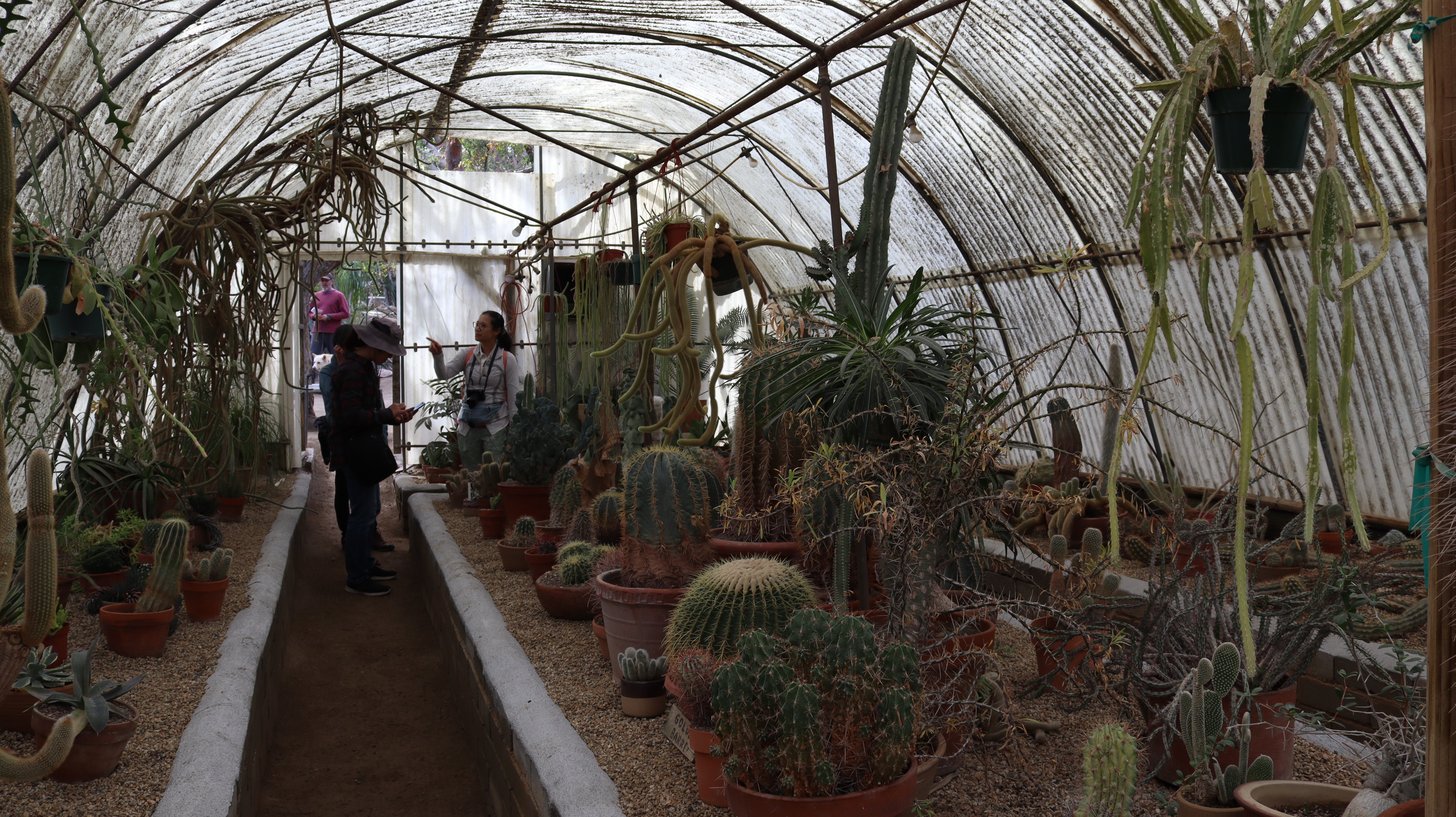
Inside the Green House of the Moorten Botanical Gardens

But it dawned on me the precariousness of the site, which I was not expecting. The Green House is build with plastic sheets, the air conditioning looked very old and (maybe) out of work. There are lots of plastic cactus pots inside, those who love plants know very well how bad plastic is to ventilate the roots. This is not the arrangement based on pattern, species or design, I had the feeling of seeing plants just added here and there. The "walkway" is pretty narrow, at the point that I came across a lady who trying to dodge me, was accidentally pricked by one of the cactuses.
The Green House had one of the two entrances blocked, which is not a good idea in case of eventual fire or earthquake. 
The following pictures belong to my personal archives, they have been taken yesterday, January 7th 2023, please do not share without my permission.
The scale of the cactus is really amazing and I truly enjoyed the trails.


The ticket is $5 per adult. There is a sort of "shop" at the entrance and I bought two gifts, one for my daughter, the other for myself.

I think this outdoor armchair carved from a trunk is a real (most interesting) finding.

The Moorten Gardens point of sale.

As a side note, the web page states that some days they have 200 visitors. Besides, it is advertising weddings, and events, charging more than 1,000$. The site was not crowded but I can tell there is elder people most of all. 
After this visit, I had to go to a construction job site and then go back home. I thought it would be a good idea to go to the restroom before leaving. And here it was my main surprise, the bathroom is NOT accessible and I believe it does not have a Building and Safety permit at all. Being it so precarious, just like a siding box with no structural framing for the roof, no structural connections to the stucco walls behind, no accessible path (the path leading to it is very steep), my disgust was such, that I decided not to enter. A chemical bathroom at the construction site would be better.
I do not know if there is another bathroom facility but I had no indication otherwise. See that even the sink, the paper, the stuff around, all of it looks precarious and like abandoned. If this business is advertised for weddings, etc, for 200 people, there is no way this "white sort of storage" in my picture below, will suffice for the public and never for the purposes of safety, which is one of my main concerns. 
I hope this will be fixed in time, as it is a black stain in the gardens beauty. 

The bathroom of the Moorten Botanical Gardens is the white precarious construction in the middle. Supposedly "attached" to the house.

Wish trees at Yoko Ono's The Broad exhibition

  There is this on-going Yoko Ono's exhibition at the Broad Museum in Los Angeles, and though Yoko is not one of my favorite artists, I ...